Improving FLL Robot Game. Scissors mechanism for Lifting
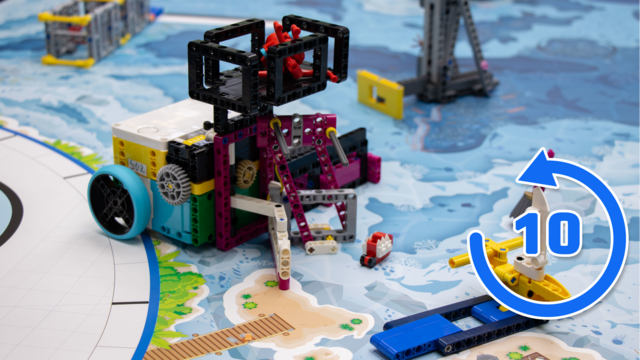
The final way for lifting our box robot is by using a scissors mechanism. In this Episode, we would discuss the benefits and advantages of this mechanism.
- #452
- 20 Mar 2017
The final way for lifting our box robot is by using a scissors mechanism. In this Episode, we would discuss the benefits and advantages of this mechanism.
The most stressed wheel in our system is the driven wheel. We've already fixed the problem with the driving wheel of the scissor mechanism and now it is time to look at the drive LEGO Mindstorms wheel.
There are modifications that you must do on the FTC PushBot robot. Let's discuss them
Using everything that we've learned about LEGO Education SPIKE Prime competition programming we arrive at the final boss mission - how do we consistently reach a mission model at the other end of the field. Consistently. Every time. We use line following, motion sensor, counting of lines and border alignment. All the different concepts that we've looked at separately are now implemented together.
We use a sensor so the robot must be reliable and accurate right? Wrong. The robot is not reliable and accurate only because we use sensors and that's really important during FIRST LEGO League competition. There is a reason for this and in this tutorial we demonstrate and explain how the robot behaves with a basic use of the Motion Sensor to move straight. As a result you will learn why is it important not to stop at this stage and to go to the next level with more advance use of sensors.
In this video tutorial, we use the Unload Cargo Ship mission from FIRST LEGO League 2021 Cargo Connect robotics competition to demonstrate how we program the robot to keep a straight line while moving. Do we need that for this mission? Probably not, but we do it either way to demonstrate the solution in a fairly simple mission. The program uses the motion sensor to auto-correct the errors the robot is making while moving.
This is a 10 out of 10 tutorial in which the MiniBox accomplishes M08, M14, and M15 of the FIRST LEGO League 2023-2024 MASTERPIECE Challenge robotics competition. The robot is a LEGO Education SPIKE Prime box robot. In this run, the robot should consistently and reliably deliver the LEGO minifigure to its designated place and then push the M08 camera down the track to shoot the movie scene.
This is a 10 out of 10 tutorial in which the MiniBox accomplishes M14 and M15 of the FIRST LEGO League 2023-2024 MASTERPIECE Challenge robotics competition. The robot is a LEGO Education SPIKE Prime box robot. In this run, the robot should consistently and reliably deliver the LEGO minifigures to their designated places.
In this video tutorial, we demonstrate a full run of all the missions in the FIRST LEGO League 2023-2024 MASTERPIECE Challenge robotics competition, using the MiniBox - a LEGO Education SPIKE Prime robot.
These kinds of runs are extremely useful for teams looking to see how they can tackle the entire range of missions, pushing their accuracy, speed, and self-control to the limit.
In this video we are solving part of the FIRST LEGO League Senior Solutions challange missions (FLL 2012) using LEGO Mindstorms NXT robots. I make a step by step explanation of each move I make. The goal of this video is to help you with ideas and suggestions on how one should look at the missions.
In this episode we are showing the great similiarity between the sensors in NXT Mindstorms. We are solving a common problem - How to make a robot that do not fall from the table. We are using the Ultrasonic sensor, Light Sensor and Touch Sensor to solve the same problem, but with three different sensors.
In Episode 58 we introduced you to a LEGO Mindstorms EV3 Modular robot. In this tutorial, we show you how we reached that construction. We start from a construction found on the Internet and take you through the process of examining and improving it, till we reach a more stable and reliable robot.
In this second video lesson on catapults we improve the stability of the base of the robot. An important feature of the new base is that it is not bending. Use the same principle in all of your constructions to achieve better, stronger robots.
We are showing the first way we could position the motors on the robot construction. This seems to be challenging for many robot builders and that's why we are going to do it in a few different ways in the next few video tutorials from the series.
This third way of positioning the LEGO Mindstorms EV3 motors on the robot seems to be the most productive with the most advantages. We have named it "correct", but we completely understand there might be other even more efficient ways to position the motors on the robot.