

WRO Catch and Move Robot. Full Version
Building instructions for the LEGO Mindstorms EV3 robot used for accomplishing WRO 2014 mission. It is the full robot with the lift at the top
- #126
- 01 May 2016
- 1
Building instructions for the LEGO Mindstorms EV3 robot used for accomplishing WRO 2014 mission. It is the full robot with the lift at the top

Umjaho - from the language of the Zulu tribe. It means "competition"
This LEGO Mindstorms EV3 robot has three sensors - touch, color and ultrasonic. When the touch sensor is pressed the robot starts moving. The color sensor is used for following lines and the ultrasonic sensor is used to detect any robots in front of the robot.

Playing Football with robots is extremely fun. It could be part of the classes, it could be part of demonstration days. The Striker is a robot for handling the ball and attacking the goalkeeper.

A simple active attachment that could be added to the Box Robot Chassis.
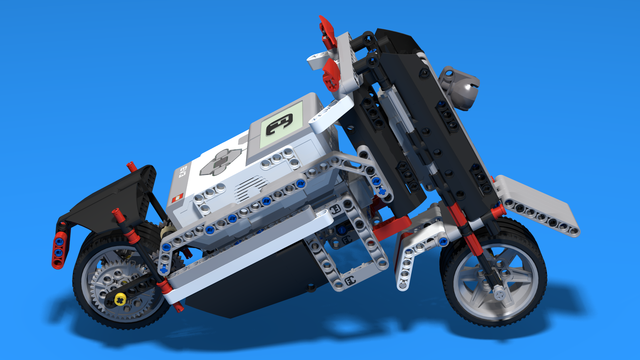
It's fast. It's on two wheels. It's a motorcycle. And this one is built from LEGO Mindstorms EV3 sets with the use of one additional Medium Motor. If you have two medium motors, great. If you don't have you can build the Handlebar - Chopper Motorcycle built with LEGO Mindstorms EV3, because it uses one large and one medium motor that are available in any EV3 set.
Currently, the motorcycle has no sensors. It's more of an exercise in construction, but if you attach sensors and think of a way to attach them send us a picture.
Join the course A robot a "day" keeps the questions awake where we will further discuss the motors, how to build them and what tasks to accomplish with them.
You can also download the program from here.

This is the base module of EV3 Kinesthetic and Memory Game. The goal of this module is to present a variety of places for the rest of the modules to be attached.
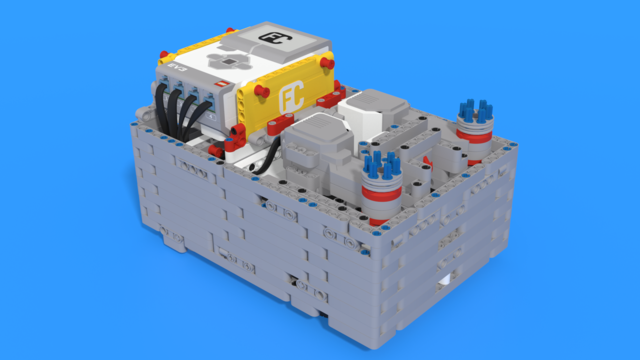
This is a LEGO Mindstorms EV3 competition robot used in FIRST LEGO League Season 2018-2019 Into Orbit following a Box Robot principle. The robot has passed through the following competitions in Brazil:
Local competition in scho
Regional: Northeast
National: Rio de Janeiro
International: Uruguay
The robot is an modular construction that you could easily build upon. It is not entirely "clean" as it has parts of it not optimezed as in the other box robots, but it is a nice example and a great work from the FLL team.

The CubeHunter uses the ultrasonic sensor to detect a ball or cube. Next, the robot catches it and reads the colour of the object using the EV3 colour sensor. The building instructions are suitable for classes with students and if you are working alone at home.

This is a LEGO Mindstorms EV3 competition robot used in FIRST LEGO League competitions and used by a team in Brazilian regionals. It followsa Box Robot principle. The robot has passed through the following competitions in Brazil:
Local competition in scholl
Regional: Northeast
National: Rio de Janeiro
International: Uruguay
It is not entirely "clean" as it has parts of it not optimezed as in the other box robots, but it is a nice example and a great work from the FLL team.

A fearsome and dangerous robot. It will find a place to hide and patiently wait in ambush.
NB! This robot requres bluetooth connectivity, as its USB port is blocked in the construction.

The central axle of the robot is most of the time the most important. The robot moves forward and does things with this axle. It is important to learn to you could extend such axles, and change the level and position of the extensions.
This is a LEGO Mindstorms EV3/NXT robot attachment.

The first thing every student wants to build is a LEGO Mindstorms EV3 robot with treads. Well, we have one. Take a look. It's really funny.
Can you make it move? Send us a video or picture in the comment section below.
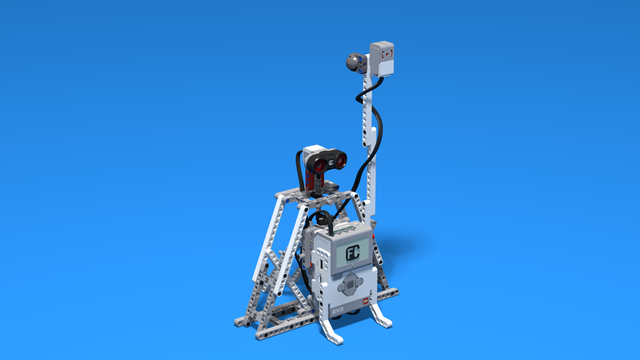
WatchTower is a pretty self-explanatory robot. It detects intruders by sensing the vibrations they make while walking or digging beneath it. For this purpose, it uses a Gyro sensor, which could be incredibly sensitive under the right circumstances. The Ultrasonic sensor that sits on top of a medium motor starts locating the intruders when the Gyro sensor detects them.

A nice little robot that can tell if there is anything on top of it. It only uses one touch sensor. The idea of the robot is to be used in classes with students to explore different interesting security options. This robot in particular could detect when the object placed on it gets "stollen". Have you ever watched Indiana Jones? :)

This robot is a simplified spinoff of the Box Robots (Box Robot 1 and Box Robot 2). It may be build with a single set, but it will require extra technic beams 7x5 with open centers.
The name of the robot - "Squmo" is derived from the ancient tradition of connecting two words to make on and hense - "Square sumo" because "Squmo".
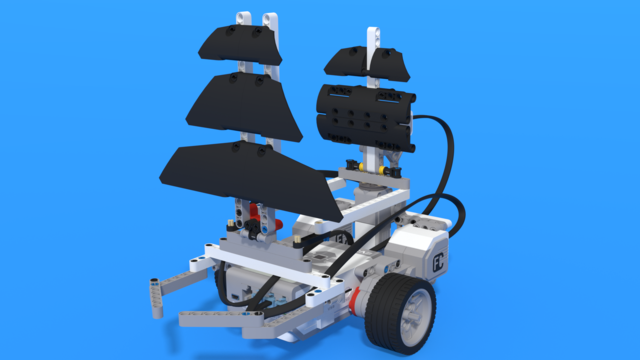
Yolanda comes from the novel "Yolanda, the Black Corsair's Daughter" by Emilio Salgari.
The robot resembles a sailship with two masts. The mast in the back is connected to a medium motor, which allows it to rotate with some limits. The mast also has a gyro sensor in the back. These are placed so that the gyro sensor detects which way "the wind is blowing" and moves the sails that way. The second mast is connected to the first one so that it moves accordingly. The robot also uses two large motors to move.

This LEGO Mindstorms robot base is small, compact and packed in a very small volume. The goal of this constructions is to be used as a base and to show yet another way to experiment with adding motors to the brick.

This is the simplest possible line following robot. It has just one sensor in the front between the two driving wheels and uses beams as pivots instead of a third wheel. Try it out. Follow the building instructions and start following lines in a number of minutes.

Susan comes from Sue, which is the name of the largest fully preserved specimen of T-Rexes.
Mark comes from Marc Bolan, who is the lead singer/gutarist of the band T-Rex.
The robot is made to resemble a T-Rex (Susan) chasing a car (Mark).
The T-Rex uses a Large motor to go forward and backward. The other Large motor is used for the car, which resembles a very simple 4-wheel vechicle. Susan's task is to spot Mark using the current power option of the motor rotation sensor. As T-Rexes can not notice you if you are moving very slow, Mark is trying his best to move really slow so that he doesn't get spotted!

Here is another great example of a large multi-purpose attachment used in FIRST LEGO League competitions. This one is specifically for the 2017-2018 Hydrodynamics competitions and is doing a number of missions. (01) Pipe removal, (06) Water Treatment and (08) Manhole cover.
The attachment consists of two parts. The first part is placed on the robot while the second part is in front of the robot and the robot pushes it. While working on the field the robot leaves the second part on the Water Treatment plant and when returning back collects it back and returns to base.
The goal of the attachment is for you to build it and experiment with it with the existing field. Use Box Robot 2 as a robot base on which to add the attachments.